History
Prehistory and antiquity
Thracians, one of the three primary ancestral groups of modern Bulgarians,
[15] began appearing in the region during the
Iron Age.
[16] In the late 6th century BC,
Darius the Great incorporated all of what is nowadays Bulgaria into his vast
Achaemenid Persian Empire.
[17] Following the
Ionian Revolt, Persian rule over the Balkans (which included the nowadays territory of Bulgaria), loosened.
[18] In 492 BC, his general
Mardonius, resubjugated all of
Thrace and conquered
Macedon.
[19] Following the
Persian defeat in Greece, most of the numerous Thracian tribes were united in the
Odrysian kingdom in the 470s BC by king
Teres.
[20][21][22] Prior to the overthrow of the Persian Empire, the Thracians were eventually subjugated by
Alexander the Great and later by the
Romans in 46 AD. After the division of the
Roman Empire in 5th century the area fell under
Byzantine control. By this time,
Christianity had already spread in the area. A small
Gothic community in
Nicopolis ad Istrum produced the first
Germanic language book in the 4th century, the
Wulfila Bible.
[23][24] The
first Christian monastery in Europe was established around the same time by
Saint Athanasius in central Bulgaria.
[25] From the 6th century the easternmost
South Slavs gradually settled in the region, assimilating the Hellenised or Romanised Thracians.
[26][27]
First Bulgarian Empire

Khan Krum feasts with his nobles after the battle of Pliska. His servant (far right) brings the wine-filled
skull cup of
Nicephorus I.
In 680
Bulgar tribes,
[15] under the leadership of
Asparukh moved south across the
Danube and settled in the area between the lower Danube and the
Balkan, establishing their capital at
Pliska.
[28][29] A peace treaty with Byzantium in 681 marked the beginning of the
First Bulgarian Empire. The Bulgars gradually mixed up with the local population, adopting a common language on the basis of the local
Slavic dialect.
[30]
Wars with
Magyars and
Pechenegs and the spread of the
Bogomil heresy weakened Bulgaria after Simeon's death.
[37][38] Consecutive
Rus' and Byzantine invasions resulted in the seizure of the capital
Preslav by the Byzantine army in 971.
[39] Under
Samuil, Bulgaria briefly recovered from these attacks,
[40] but this rise ended when Byzantine emperor
Basil II defeated the Bulgarian army at
Klyuch in 1014. Samuil died shortly after the battle,
[41] and by 1018 the Byzantines had ended the First Bulgarian Empire.
[42]
Second Bulgarian Empire
Kaloyan, the third of the Asen monarchs, extended his dominion to
Belgrade and
Ohrid. He acknowledged the spiritual supremacy of
the Pope and received a royal crown from a
papal legate.
[46] The empire reached its zenith under
Ivan Asen II (1218–1241), when commerce and culture flourished.
[46] The strong economic and religious influence of Tarnovo made it a "
Third Rome", unlike the already declining Constantinople.
[47]
The country's military and economic might declined after the Asen dynasty ended in 1257, facing internal conflicts, constant Byzantine and Hungarian attacks and
Mongol domination.
[46][48] By the end of the 14th century, factional divisions between
the feudal landlords and the spread of Bogomilism had caused the Second Bulgarian Empire to split into three tsardoms—
Vidin,
Tarnovo and
Karvuna—and several semi-independent principalities that fought each other, along with Byzantines, Hungarians, Serbs,
Venetians and
Genoese. By the late 14th century the
Ottoman Turks had started their conquest of Bulgaria and had taken most towns and fortresses south of the Balkan mountains.
[46]
Ottoman rule
Tarnovo was captured by the Ottomans after a three-month siege in 1393. After the
Battle of Nicopolis in 1396 brought about the fall of the Vidin Tsardom, the Ottomans conquered all Bulgarian lands south of the Danube. The nobility was eliminated and the peasantry was
enserfed to Ottoman masters,
[49] with much of the educated clergy fleeing to other countries.
[50] Under the Ottoman system, Christians were considered an
inferior class of people. Thus, Bulgarians, like other Christians, were subjected to heavy taxes and a small portion of the Bulgarian populace experienced partial or complete
Islamisation,
[51] and their culture was suppressed.
[50] Ottoman authorities established the Rum
Millet, a religious administrative community which governed all Orthodox Christians regardless of their ethnicity.
[52] Most of the local population gradually lost its distinct national consciousness, identifying as Christians.
[53][54] However, the clergy remaining in some isolated monasteries kept it alive, and that helped it to survive as in some rural, remote areas,
[55] as well as in the militant
Catholic community in the northwestern part of the country.
[56]
Third Bulgarian state
The
Treaty of San Stefano was signed on 3 March 1878 by Russia and the Ottoman Empire, and included a provision to set up an autonomous Bulgarian principality roughly on the territories of the Second Bulgarian Empire.
[60][61] The other
Great Powers immediately rejected the treaty out of fear that such a large country in the Balkans might threaten their interests. It was superseded by the subsequent
Treaty of Berlin, signed on 13 July, provided for a much smaller state comprising
Moesia and the region of
Sofia, leaving large populations of Bulgarians outside the new country.
[60][62] This played a significant role in forming Bulgaria's militaristic approach to foreign affairs during the first half of the 20th century.
The Bulgarian principality won
a war against Serbia and incorporated the semi-autonomous Ottoman territory of
Eastern Rumelia in 1885, proclaiming itself an independent state on 5 October 1908.
[64] In the years following independence, Bulgaria increasingly militarised and was often referred to as "the Balkan
Prussia".
[65][66]
Between 1912 and 1918, Bulgaria became involved in three consecutive conflicts—two
Balkan Wars and
World War I. After a disastrous defeat in the
Second Balkan War, Bulgaria again found itself fighting on the losing side as a result of its alliance with the
Central Powers in World War I. Despite fielding more than a quarter of its population in a 1,200,000-strong army
[67][68] and achieving several decisive victories at
Doiran and
Dobrich, the country capitulated in 1918. The war resulted in significant territorial losses, and a total of 87,500 soldiers killed.
[69] More than 253,000 refugees
immigrated to Bulgaria from 1912 to 1929 due to the effects of these wars,
[70] placing additional strain on the already ruined national economy.
[71]
The political unrest resulting from these losses led to the establishment of a royal
authoritarian dictatorship by tsar
Boris III (1918–1943). Bulgaria entered World War II in 1941 as a member of
the Axis but declined to participate in
Operation Barbarossa and saved its Jewish population from deportation to
concentration camps. The sudden death of Boris III in the summer of 1943 pushed the country into political turmoil as the war turned against Germany and the Communist guerrilla movement gained momentum. The government of
Bogdan Filov subsequently failed to achieve peace with the Allies. Bulgaria did not comply with Soviet demands to expel German forces from its territory, resulting in a declaration of war and an invasion by the USSR in September 1944. The Communist-dominated
Fatherland Front took power, ended participation in the Axis and joined the Allied side until the war ended.
[74]
The
left-wing uprising of 9 September 1944 led to the abolition of monarchic rule, but it was not until 1946 that a
single-party people's republic was established.
[75] It became a part of the Soviet sphere of influence under the leadership of
Georgi Dimitrov (1946–1949), who laid the foundations for a rapidly industrialising
stalinist state which was also highly repressive with thousands of dissidents executed.
[76][77][78] By the mid-1950s standards of living rose significantly,
[79] while political repressions were lessened. By the 1980s both national and per capita GDP quadrupled,
[81] but the economy remained prone to debt spikes, the most severe taking place in 1960, 1977 and 1980.
[82] The Soviet-style
planned economy saw some market-oriented policies emerging on an experimental level under
Todor Zhivkov (1954–1989). His daughter
Lyudmila bolstered national pride by promoting Bulgarian heritage, culture and arts worldwide. In an attempt to erase the identity of the
ethnic Turk minority, an assimilation campaign was launched in 1984 which included closing mosques and forcing ethnic Turks to adopt Slavic names. These policies (combined with the end of communist rule in 1989) resulted in the emigration of some 300,000 ethnic Turks to Turkey.
[85][86]
Under the influence of the
collapsing of the Eastern Bloc, on 10 November 1989 the Communist Party gave up its political monopoly, Zhivkov resigned, and Bulgaria embarked on a transition to a parliamentary democracy.
[87] The first free elections in June 1990 were won by the
Bulgarian Socialist Party (BSP, the freshly renamed Communist Party).
[88] A
new constitution that provided for a relatively weak elected President and for a Prime Minister accountable to the legislature was adopted in July 1991. The new system initially failed to improve living standards or create economic growth—the average quality of life and economic performance remained lower than under Communism well into the early 2000s.
[89] A 1997 reform package restored economic growth, but living standards continued to suffer.
[90] After 2001 economic, political and geopolitical conditions improved greatly, and Bulgaria achieved high Human Development status.
[92] It became a member of
NATO in 2004
[93]and participated in the
War in Afghanistan. After several years of reforms it joined the
European Union in 2007 despite continued concerns about government corruption.
[94]
Geography
Bulgaria occupies a portion of the eastern
Balkan peninsula, bordering five countries—
Greece and
Turkey to the south,
Macedonia and
Serbia to the west, and
Romania to the north. The land borders have a total length of 1,808 kilometres (1,123 mi), and the coastline has a length of 354 kilometres (220 mi). Its total area of 110,994 square kilometres (42,855 sq mi) ranks it as the world's 105th-largest country.
[96][97] Bulgaria's geographic coordinates are
43° N 25° E.
[98]
Left: Pirin Mountain in western Bulgaria.
Right:
Maslen nos Primorsko on the Black Sea coast.
The Balkan mountains run laterally through the middle of the country. The mountainous southwest of the country has two alpine ranges—
Rila and
Pirin, which border the lower but more extensive
Rhodope Mountains to the east. Bulgaria is home to the highest point of the Balkan peninsula,
Musala, at 2,925 metres (9,596 ft)
[99] and its lowest point is sea level. Plains occupy about one-third of the territory, while plateaus and hills occupy 41 per cent. The country has a dense network of about 540 rivers, most of which are relatively small and with low water levels.
[101] The longest river located solely in Bulgarian territory, the
Iskar, has a length of 368 kilometres (229 mi). Other major rivers include the
Struma and the
Maritsa in the south.
Bulgaria has a dynamic climate, which results from its being positioned at the meeting point of
Mediterranean and continental air masses and the barrier effect of its mountains. Northern Bulgaria averages 1 °C (1.8 °F) cooler and registers 200 millimetres (7.9 in) more precipitation annually than the regions south of the Balkan mountains. Temperature amplitudes vary significantly in different areas. The lowest recorded temperature is −38.3 °C (−36.9 °F), while the highest is 45.2 °C (113.4 °F).
[102] Precipitation averages about 630 millimetres (24.8 in) per year, and varies from 500 millimetres (19.7 in) in
Dobrudja to more than 2,500 millimetres (98.4 in) in the mountains. Continental air masses bring significant amounts of snowfall during winter.
Environment
Bulgaria adopted the
Kyoto Protocol[104] and achieved the protocol's objectives by reducing
carbon dioxide emissions from 1990 to 2009 by 30 percent.
[105] However, pollution from factories and metallurgy works and severe
deforestation continue to cause major problems to the health and welfare of the population.
[106] In 2013, air pollution in Bulgaria was more severe than any other European country.
[107] Urban areas are particularly affected by energy production from coal-based powerplants and automobile traffic,
[108][109] while pesticide usage in the agriculture and antiquated industrial sewage systems produce extensive soil and water pollution with chemicals and
detergents.
[110] Bulgaria is the only EU member which does not recycle municipal waste,
[111] although an
electronic waste recycling plant opened in June 2010.
[112] The situation has improved in recent years, and several government-funded programmes have been put into place in an attempt to reduce pollution levels.
[110] According to Yale University's 2012
Environmental Performance Index, Bulgaria is a "modest performer" in protecting the environment.
[113] In November 2014 the
Maritsa Iztok-2 lignite fired power station was ranked as the industrial facility that is causing the highest damage costs to
health and the
environment in Bulgaria and the entire European Union by the
European Environment Agency.
[114]
Surface waters in Bulgaria as a whole are in good condition. Over 75% of the length of rivers in the country meet the standards for good quality. The improvement of water quality started 1998 - there is a clear trend of sustainability and slight improvement of all indicators for water quality between 1998 and 2007.
[115]
Biodiversity
The interaction of climatic, hydrological, geological and topographical conditions have produced a relatively wide variety of plant and animal species.
[117] Bulgaria's biodiversity
is conserved in three national parks, 11 nature parks
[118] and 17
biosphere reserves.
[119] Nearly 35 per cent of its land area consists of forests,
[120] where some of the oldest trees in the world, such as
Baikushev's pine and the
Granit oak,
[121] grow. Most of the plant and animal life is central European, although representatives of Arctic and alpine species are present at high altitudes.
[122] Its flora encompass more than 3,800 species of which 170 are
endemic and 150 are considered endangered.
[123] A checklist of larger
fungi of Bulgaria reported that more than 1,500 species occur in the country.
[124] Animal species include
owls,
rock partridges,
wallcreepers[122] and
brown bears.
[125] The
Eurasian lynx and the
eastern imperial eagle have small, but growing populations.
[126]
In 1998, the Bulgarian government approved the National Biological Diversity Conservation Strategy, a comprehensive programme seeking the preservation of local ecosystems, protection of endangered species and conservation of genetic resources.
[127] Bulgaria has some of the largest
Natura 2000 areas in Europe covering 33.8% of its territory.
[128]
Politics

The National Assembly building in
Sofia.
Bulgaria is a
parliamentary democracy in which the most powerful executive position is that of prime minister. The political system has three branches—legislative, executive and judicial, with
universal suffrage for
citizens at least 18 years old. The
Constitution of Bulgaria provides also possibilities of direct democracy.
[129] Elections are supervised by an independent Central Election Commission that includes members from all major political parties. Parties must register with the commission prior to participating in a national election. Normally, the prime minister-elect is the leader of the party receiving the most votes in parliamentary elections, although this is not always the case.
Political parties gather in the
National Assembly, which consists of 240 deputies elected to four-year terms by direct popular vote. The National Assembly has the power to enact laws, approve the budget, schedule presidential elections, select and dismiss the
Prime Minister and other ministers, declare war, deploy troops abroad, and ratify international treaties and agreements. The
president serves as the
head of state and
commander-in-chief of the armed forces, and has the authority to return a bill for further debate, although the parliament can override the
presidential veto by a simple majority vote of all members of parliament.
Until February 2013 GERB had 117 seats in the National Assembly, ruling as a
minority government without support from the other political parties in the parliament.
[132] The government resigned on 20 February 2013 after
nationwide protests caused by high costs of utilities, low living standards
[133] and the failure of the democratic system.
[134] The protest wave was marked by self-immolations, spontaneous demonstrations and a strong sentiment against political parties.
[135] As a consequence, the Parliament was dissolved and a new provisional government was set up by the President.
The subsequent snap elections in
May 2013 elections resulted in a narrow GERB win.
[136] However, with no support from the other three political parties that entered the parliament, on 24 May, GERB leader Borisov returned the president's mandate to try and form a government. The Bulgarian Socialist Party nominated ex-Finance Minister
Plamen Oresharski for the post of Prime Minister.
[137] He was appointed on 29 May 2013.
[138]
Only two weeks after its initial formation the Oresharski government came under criticism and had to deal with
country-wide protests by the citizens, with those in Sofia reaching up to 11 000 participants.
[139] One of the main reasons for these protests was the controversial appointment of media mogul
Delyan Peevski as a chief of the National Security State Agency.
[140]The protests continued over the lifetime of the Oresharski government. In all, the government survived 5
votes of no-confidence before voluntarily resigning.
[141] Following an agreement from the three largest parties (GERB, BSP and DPS) to hold early parliamentary elections for 5 October 2014,
[142] the cabinet agreed to resign by the end of July,
[143] with the resignation of the cabinet becoming a fact on 23 July 2014.
[144] The next day parliament voted 180-8 (8 abstained and 44 were absent) to accept the government's resignation.
[145] Following the vote, President Plevneliev offered the mandate to GERB to try and form government, but it was refused.
[146] The next day the BSP returned the mandate as well.
[147] On 30 July, the DPS refused the mandate as well.
[148] Finally, on 6 August, a
caretaker government led by
Georgi Bliznashki was sworn into office and the Oresharski government was officially dissolved.
Bulgaria has a typical
civil law legal system.
[158] The judiciary is overseen by the Ministry of Justice. The Supreme Administrative Court and Supreme Court of Cassation are the highest courts of appeal and oversee the application of laws in subordinate courts. The Supreme Judicial Council manages the system and appoints judges. Bulgaria's judiciary, along with other institutions, remains one of Europe's most corrupt and inefficient.
[159][160][161][162]
Law enforcement is carried out by organisations mainly subordinate to the
Ministry of the Interior.
[163] The
National Police Service (NPS) combats general crime, maintains public order and supports the operations of other law enforcement agencies.
[164] NPS fields 27,000 police officers in its local and national sections.
[165] The Ministry of Interior also heads the Border Police Service and the
National Gendarmerie—a specialised branch for anti-terrorist activity, crisis management and riot control. Counterintelligence and national security are the responsibility of the State Agency for National Security, established in 2008.
[166]
Administrative divisions
Bulgaria is a
unitary state.
[167] Since the 1880s, the number of territorial management units has varied from seven to 26.
[168] Between 1987 and 1999 the administrative structure consisted of nine provinces (
oblasti, singular
oblast). A new administrative structure was adopted in parallel with the decentralisation of the economic system.
[169] It includes 27 provinces and a metropolitan capital province (Sofia-Grad). All areas take their names from their respective capital cities. The provinces subdivide into 264
municipalities.
Municipalities are run by mayors, who are elected to four-year terms, and by directly elected municipal councils. Bulgaria is a highly
centralised state, where the national Council of Ministers directly appoints regional governors and all provinces and municipalities are heavily dependent on it for funding.
Foreign relations and the military
Bulgaria became a member of the
United Nations in 1955 and since 1966 has been a non-permanent member of the
Security Council three times, most recently from 2002 to 2003.
[170] Bulgaria was also among the founding nations of the
Organization for Security and Co-operation in Europe (OSCE) in 1975. It joined
NATO on 29 March 2004, signed the European Union
Treaty of Accession on 25 April 2005,
[93][171] and became a full member of the European Union on 1 January 2007.
[94] Polls carried out seven years after the country's accession to the EU found only 15% of Bulgarians felt they had personally benefited from membership, with almost 40% of the population saying they would not bother to vote in the
2014 EU elections.
[172] Euro-Atlantic integration became a priority for the country since the fall of Communism, although the Communist leadership also had aspirations of leaving the Warsaw Pact and joining the
European Communities by 1987.
[173][174][175] Bulgaria's relationship with its neighbours since 1990 has generally been good. The country also plays an important role in promoting regional security.
[176] Bulgaria has an active tripartite economic and diplomatic collaboration with Romania and Greece,
[177] maintains strong relations with EU members, the United States and Russia, and continues to improve its traditionally good ties with
China[178] and
Vietnam.
[179] The
HIV trial in Libya, which followed after the imprisonment of several Bulgarian nurses in
Benghazi in 1998, had a significant impact on relations between Bulgaria, the European Union, and Libya. It resulted in the release of the nurses by Muammar Gaddafi's government, which was granted a contract to receive a nuclear reactor and weapons supplies from France in exchange.
[180]
Bulgaria hosted six
KC-135 Stratotanker aircraft and 200 support personnel for the war effort in Afghanistan in 2001, which was the first stationing of foreign forces on its territory since World War II.
[14] International military relations were further expanded in April 2006, when Bulgaria and the United States signed a defence cooperation agreement providing for the usage of
Bezmer and
Graf Ignatievo air bases, the
Novo Selo training range, and a logistics centre in
Aytos as
joint military training facilities.
[181] The same year
Foreign Policy magazine listed Bezmer Air Base as one of the six most important overseas facilities used by the
USAF due to its proximity to the
Middle East.
[182] A total of 756 troops are
deployed abroad as part of various UN and NATO missions. Historically, Bulgaria deployed significant numbers of military and civilian advisors in Soviet-allied countries, such as
Nicaragua and
Libya (more than 9,000 personnel).
[184]
Domestic defence is the responsibility of the all-
volunteer military of Bulgaria, consisting of
land forces,
navy and
air force. The land forces consist of two mechanised brigades and eight independent regiments and battalions; the air force operates 106 aircraft and air defence systems in six air bases, and the navy operates a variety of ships, helicopters and coastal defence measures.
[185] Following a series of reductions beginning in 1990, the number of active troops contracted from 152,000 in 1988 to about 32,000 in the 2000s,
[187] supplemented by a reserve force of 302,500 soldiers and officers and 34,000 paramilitary servicemen.
[188] The inventory is mostly of Soviet origin, such as
MiG-29 fighters,
SA-10 Grumble SAMs and
SS-21 Scarab short-range
ballistic missiles. By 2020 the government will spend $1.4 billion for the deployment of new fighter jets, communications systems and
cyber warfare capabilities.
[189] Total military spending in 2009 cost $819 million.
[190]
Economy
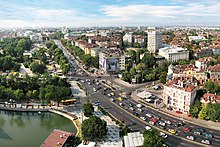
Sofia, the financial heart of the country.
Bulgaria has an emerging
market economy[191] in the upper middle income range,
[192] where the private sector accounts for more than 80 per cent of GDP.
[193] From a largely agricultural country with a predominantly rural population in 1948, by the 1980s Bulgaria had transformed into an industrial economy with scientific and technological research at the top of its budgetary expenditure priorities.
[194] The loss of
COMECON markets in 1990 and the subsequent "
shock therapy" of the planned system caused a steep decline in industrial and agricultural production, ultimately followed by an economic collapse in 1997.
[195][196] The economy largely recovered during a period of rapid growth several years later,
[195] but the average salary remains one of the lowest in the EU at 820 leva (€419) per month in September 2014.
[197] More than a fifth of the labour force are employed on a
minimum wage of €1 per hour.
[198] Wages, however, account for only half of the total household income,
[199] owing to the substantial
informal economy which amounts to almost 32% of GDP.
[200] Bulgarian PPS
GDP per capita stood at 47 per cent of the EU average in 2013 according to
Eurostat data,
[201] while the cost of living was 48 per cent of the average.
[202] The currency is the
lev, which is pegged to the euro at a rate of 1.95583 levа for 1 euro.
[203] Bulgaria is not part of the
eurozone and has abandoned its plans to adopt the euro.
[204]

Rates of economic growth (green and red) and unemployment (blue).
Economic indicators have worsened amid the
late-2000s financial crisis. After several consecutive years of high growth, GDP contracted 5.5 per cent in 2009 and unemployment remains above 12 per cent.
[205][206] Industrial output declined 10 per cent, mining by 31 per cent, and ferrous and metal production marked a 60 per cent drop.
[207] Positive growth was restored in 2010,
[206] although investments and consumption continue to decline steadily due to rising unemployment.
[208] The same year, intercompany debt exceeded €51 billion, meaning that 60 per cent of all Bulgarian companies were mutually indebted.
[209] By 2012, it had increased to €83 billion, or 227 per cent of GDP.
[210] The government implemented strict austerity measures with IMF and EU encouragement to some positive fiscal results, but the social consequences of these measures have been "catastrophic" according to the
International Trade Union Confederation.
[211] Corruption remains another obstacle to economic growth. Bulgaria is one of the most corrupt European Union members and ranks 75th in the
Corruption Perceptions Index.
[212] Weak law enforcement and overall low capacity of civil service remain as challenges in curbing corruption. However, fighting against corruption has become the focus of the government because of the EU accession, and several anti-corruption programs have been undertaken by different government agencies.
[213]

Bulgaria (orange) and its largest export partners by share of total exports.
Economic activities are fostered by the lowest personal and corporate income tax rates in the EU,
[214] and the second-lowest
public debt of all member states at 16.5 per cent of GDP in 2012.
[215] In 2013, GDP (
PPP) was estimated at $119.6 billion, with a per capita value of $16,518.
[3] Sofia and the surrounding
Yugozapaden planning area are the most developed region of the country with a per capita PPS GDP of $27,282 in 2011.
[216] Bulgaria is a net receiver of funds from the EU. The absolute amount of received funds was €589 million in 2009.
[217]
The labour force is 2.45 million people,
[218] of whom 7.1 per cent are employed in agriculture, 35.2 per cent are employed in industry and 57.7 per cent are employed in the services sector.
[219] Extraction of metals and minerals, production of
chemicals,
machinery and vehicle components,
[220]petroleum refining[221] and steel are among the major industrial activities.
[222] Mining and its related industries employ a total of 120,000 people and generate about five per cent of the country's GDP.
[223] Bulgaria is Europe's sixth-largest coal producer.
[223][224] Local deposits of coal, iron, copper and lead are vital for the manufacturing and energy sectors. Almost all top export items of Bulgaria are industrial commodities such as oil products, copper products and pharmaceuticals.
[226] Bulgaria is also a net exporter of agricultural and food products, of which two-thirds go to
OECD countries.
[227] It is the largest global producer of perfumery essential oils such as
lavender and
rose oil.
[14][228] Agriculture has declined significantly in the past two decades. Production in 2008 amounted to only 66 per cent of that between 1999 and 2001,
[226] while cereal and vegetable yields have dropped by nearly 40 per cent since 1990.
[229] Of the services sector,
tourism is the most significant contributor to economic growth.
[230] In recent years, Bulgaria has emerged as a travelling destination with its inexpensive resorts and beaches outside the reach of the tourist industry.
[231][232] Lonely Planet ranked it among its top 10 destinations for 2011.
[233] Most of the visitors are British, Romanian, German and Russian.
[234] The capital
Sofia, the medieval capital
Veliko Tarnovo,
[235] coastal resorts
Golden Sands and
Sunny Beach and winter resorts
Bansko,
Pamporovo and
Borovets are some of the locations most visited by tourists.
[230]
Science and technology
Internet usage has increased rapidly since 2000—the number of users grew from 430,000 to 3.4 million (48 per cent penetration rate) in 2010.
[252] Telephone services are widely available, and a central digital trunk line connects most regions. More than 90 per cent of fixed lines are served by the
Bulgarian Telecommunications Company (BTC),
[254] while mobile services are provided by three operators—
Mtel,
GLOBUL and BTC/Vivacom.
[255]
Infrastructure
Bulgaria's strategic geographic location and well-developed energy sector make it a key European energy centre despite its lack of significant fossil fuel deposits.
[256] Nearly 34 percent of its electricity is produced by the
nuclear power station at Kozloduy[257] and public opinion strongly supports nuclear energy development.
[258] The rapid expansion of alternative energy sources such as wind and solar power stations
[259] make Bulgaria one of the fastest-growing wind energy producers in the world.
[260] The country aims to produce 16 percent of its electricity from renewable energy sources by 2020.
[261]
The national road network has a total length of 40,231 kilometres (24,998 mi),
[262] of which 39,587 kilometres (24,598 mi) are paved, but nearly half fall into the lowest international rating for paved roads. Railroads are a major mode of freight transportation, although highways carry a progressively larger share of freight. Bulgaria has 6,238 kilometres (3,876 mi) of railway track and currently a total of 81 km of
high-speed lines are in operation.
[263][264][265][266] Rail links are available with Romania, Turkey, Greece, and Serbia, and express trains serve direct routes to
Kiev,
Minsk,
Moscow and
Saint Petersburg.
[267] Sofia and Plovdiv are the country's air travel hubs, while Varna and Burgas are the principal maritime trade ports. Varna is also scheduled to be the first station on EU territory to receive natural gas through the
South Stream pipeline.
[268]
Demographics
Largest cities or towns in Bulgaria
2011 Census[269]
|
|---|
| Rank | Name | Province | Pop. | Rank | Name | Province | Pop. | |
|---|

Sofia

Plovdiv | 1 | Sofia | Sofia-Capital | 1,204,685 | 11 | Pernik | Pernik | 80,191 | 
Varna

Burgas |
| 2 | Plovdiv | Plovdiv | 338,153 | 12 | Haskovo | Haskovo | 76,397 |
| 3 | Varna | Varna | 334,870 | 13 | Yambol | Yambol | 74,132 |
| 4 | Burgas | Burgas | 200,271 | 14 | Pazardzhik | Pazardzhik | 71,979 |
| 5 | Ruse | Ruse | 149,642 | 15 | Blagoevgrad | Blagoevgrad | 70,881 |
| 6 | Stara Zagora | Stara Zagora | 138,272 | 16 | Veliko Tarnovo | Veliko Tarnovo | 68,783 |
| 7 | Pleven | Pleven | 106,954 | 17 | Vratsa | Vratsa | 60,692 |
| 8 | Sliven | Sliven | 91,620 | 18 | Gabrovo | Gabrovo | 58,950 |
| 9 | Dobrich | Dobrich | 91,030 | 19 | Asenovgrad | Plovdiv | 50,846 |
| 10 | Shumen | Shumen | 80,855 | 20 | Vidin | Vidin | 48,071 |
The population of Bulgaria is 7,364,570 people according to the 2011 national census. The majority of the population, or 72.5 per cent, reside in urban areas;
[2] approximately one-sixth of the total population is concentrated in Sofia.
[271][272] Bulgarians are the main ethnic group and comprise 84.8 per cent of the population.
Turkish and
Roma minorities comprise 8.8 and 4.9 per cent, respectively; some 40 smaller minorities comprise 0.7 per cent, and 0.8 per cent do not self-identify with an ethnic group.
[273] All ethnic groups speak
Bulgarian, either as a first or as a second language. Bulgarian is the only language with official status and native for 85.2 per cent of the population. The oldest written
Slavic language, Bulgarian is distinguishable from the other languages in this group through certain grammatical peculiarities such as the lack of
noun cases and
infinitives, and a suffixed
definite article.
[274][275]
Bulgaria is in a state of demographic crisis.
[276][277] It has had negative population growth since the early 1990s, when the economic collapse caused a long-lasting emigration wave.
[278] Some 937,000 to 1,200,000 people—mostly young adults—left the country by 2005.
[278][279] The
total fertility rate (TFR) was estimated in 2013 at 1.43 children born/woman, which is below the replacement rate of 2.1.
[280] A third of all households consist of only one person and 75.5 per cent of families do not have children under the age of 16.
[277] Consequently, population growth and birth rates are among the lowest in the world
[281][282]while death rates are among the highest.
[283] The majority of children are born to unmarried women (of all births 57.4 per cent were outside marriage in 2012).
[284] Bulgaria ranks 113th globally by average life expectancy, which stands at 73.6 years for both genders.
[285] The primary causes of death are similar to those in other industrialised countries, mainly
cardiovascular diseases,
neoplasms and
respiratory diseases.
[286]
Bulgaria has
a universal healthcare system financed by taxes and contributions.
[286] The National Health Insurance Fund (NHIF) pays a gradually increasing portion of the costs of
primary healthcare. Projected healthcare expenditures for 2013 amount to 4.1 per cent of GDP.
[288] The number of doctors is above the EU average with 181 physicians per 100,000 people,
[289] but distribution by fields of practice is uneven, there is a severe shortage of nurses and other medical personnel, and the quality of most medical facilities is poor.
[290] Personnel shortages in some fields are so severe that patients resort to seeking treatment in neighboring countries.
[291]
Government estimates from 2003 put the literacy rate at 98.6 per cent, with no significant difference between the sexes. Educational standards have been
traditionally high, although still far from European benchmarks and in continuing deterioration for the past decade.
[293] Bulgarian students were among the highest-scoring in the world in terms of reading in 2001, performing better than their Canadian and German counterparts; by 2006, scores in reading, math and science had deteriorated. State expenditures for education are far below the European Union average.
[293] The
Ministry of Education, Youth and Science partially funds public schools, colleges and universities, sets criteria for textbooks and oversees the publishing process.
[294] The State provides free education in primary and secondary public schools. The educational process spans through 12 grades, where grades one through eight are primary and nine through twelve are secondary level.
[294] High schools can be technical, vocational, general or specialised in a certain discipline, while higher education consists of a 4-year
bachelor degree and a 1-year Master's degree.
[295]
The Constitution of Bulgaria defines it as a
secular state with guaranteed religious freedom, but designates
Orthodoxy as a "traditional" religion.
[296] The
Bulgarian Orthodox Church gained
autocephalous status in 927 AD,
[297][298] and currently has 12 dioceses and over 2,000 priests.
[299]More than three-quarters of Bulgarians subscribe to Eastern Orthodoxy.
[300] Sunni Muslims are the second-largest community and constitute 10 per cent of the religious makeup, although a majority of them do not pray and find the use of
Islamic veils in schools unacceptable.
[301] Less than three per cent are affiliated with other religions, 11.8 per cent do not self-identify with a religion and 21.8 per cent refused to state their beliefs.
[300]
Culture
Traditional Bulgarian culture contains mainly
Thracian,
Slavic and
Bulgar heritage, along with
Greek,
Roman,
Ottoman,
Persian and
Celtic influences.
[302][303][304] Nine historical and natural objects have been inscribed in the list of
UNESCO World Heritage Sites: the
Madara Rider, the Thracian tombs in
Sveshtari and
Kazanlak, the
Boyana Church, the
Rila Monastery, the
Rock-hewn Churches of Ivanovo,
Pirin National Park,
Sreburna Nature Reserve and the ancient city of
Nesebar.
[305] Nestinarstvo, a ritual fire-dance of Thracian origin,
[306] is included in the list of
UNESCO Intangible Cultural Heritage.
[307] Fire is an essential element of Bulgarian folklore, used to banish evil spirits and diseases. Bulgarian folklore personifies illnesses as witches and has a wide range of creatures, including
lamya,
samodiva (
veela) and
karakondzhul.
[308] Some of the customs and rituals against these spirits have survived and are still practised, most notably the
kukeri and survakari.
[309] Martenitsa is also widely celebrated.
[310]

Visitors inside the
Big Air Package, an art installation by Christo, 2013
Bulgarian folk music is by far the most extensive traditional art and has slowly developed throughout the ages as a fusion of Eastern and Western influences. It contains Far Eastern, Oriental, medieval Eastern Orthodox and standard Western European tonalities and modes.
[319] The music has a distinctive sound and uses a wide range of traditional instruments, such as
gadulka,
gaida (
bagpipe),
kaval and
tupan. One of its most distinguishing features is
extended rhythmical time, which has no equivalent in the rest of European music.
[14] The
State Television Female Vocal Choir is the most famous performing folk ensemble, and received a
Grammy Award in 1990.
[320] Bulgaria's written musical composition can be traced back to the early Middle Ages and the works of
Yoan Kukuzel (c. 1280–1360).
[321] Classical music, opera and ballet are represented by composers
Emanuil Manolov,
Pancho Vladigerov and
Georgi Atanasov and singers
Ghena Dimitrova,
Boris Hristov and
Nikolay Gyaurov.
[322][323][324][325][326] Bulgarian performers have gained popularity in several other genres like
progressive rock (
FSB),
electropop (
Mira Aroyo) and
jazz (
Milcho Leviev).
Bulgarian cuisine is similar to those of other Balkan countries and demonstrates a strong Turkish and Greek influence.
[329] Yogurt,
lukanka,
banitsa,
shopska salad,
lyutenitsa and
kozunak are among the best-known local foods. Oriental dishes such as
moussaka,
gyuvech, and
baklava are also present. Meat consumption is lower than the European average, given a notable preference for a large variety of salads.
[329] Rakia is a traditional fruit
brandy which was consumed in Bulgaria as early as the 14th century.
[330] Bulgarian wine is known for its
Traminer,
Muskat and
Mavrud types, of which up to 200,000 tonnes are produced annually.
[331][332] Until 1989, Bulgaria was the world's second-largest wine exporter.
[333]
Bulgaria performs well in sports such as wrestling, weight-lifting, boxing, gymnastics, volleyball, football and tennis.[334] The country fields one of the leading men's volleyball teams, ranked sixth in the world according to the 2013 FIVB rankings.[335] Football is by far the most popular sport.[334] Some famous players are AS Monaco forward Dimitar Berbatov and Hristo Stoichkov, winner of the Golden Boot and the Golden Ball and the most successful Bulgarian player of all time.[336] Prominent domestic clubs include PFC CSKA Sofia[337][338] and PFC Levski Sofia. The best performance of the national team at FIFA World Cup finals came in 1994, when it advanced to the semi-finals by defeating consecutively Greece, Argentina, Mexico and Germany, finishing fourth.[334] Bulgaria has participated in most Olympic competitions since its first appearance at the 1896 games, when it was represented by Charles Champaud.[339] The country has won a total of 218 medals: 52 gold, 86 silver, and 80 bronze,[340] which puts it in 24th place in the all-time ranking., the free encyclopedia
Bulgaria (
 i
i,
;
Bulgarian:
България, tr.
Bǎlgarija [bɐɫˈɡarijɐ]), officially the
Republic of Bulgaria (Bulgarian:
Република България, tr.
Republika Bǎlgarija), is a country in
southeastern Europe. It is bordered by
Romania to the north,
Serbia and
Macedonia to the west,
Greece and
Turkey to the south, and the
Black Sea to the east. With a territory of 110,994 square kilometres (42,855 sq mi), Bulgaria is Europe's
16th-largest country.
Bulgaria's population of 7.4 million people is predominantly urbanised and mainly concentrated in the administrative centres of its
28 provinces. Most commercial and cultural activities are centred on the capital and largest city,
Sofia. The strongest sectors of the economy are heavy industry, power engineering, and agriculture, all of which rely on local natural resources.


![Location of Bulgaria (dark green)– in Europe (green & dark grey)– in the European Union (green) – [Legend]](https://en.wikipedia.org/wiki/File:EU-Bulgaria.svg)
 35.4
35.4

_E3.jpg)


.jpg)


.svg)


_(9377376402).jpg)